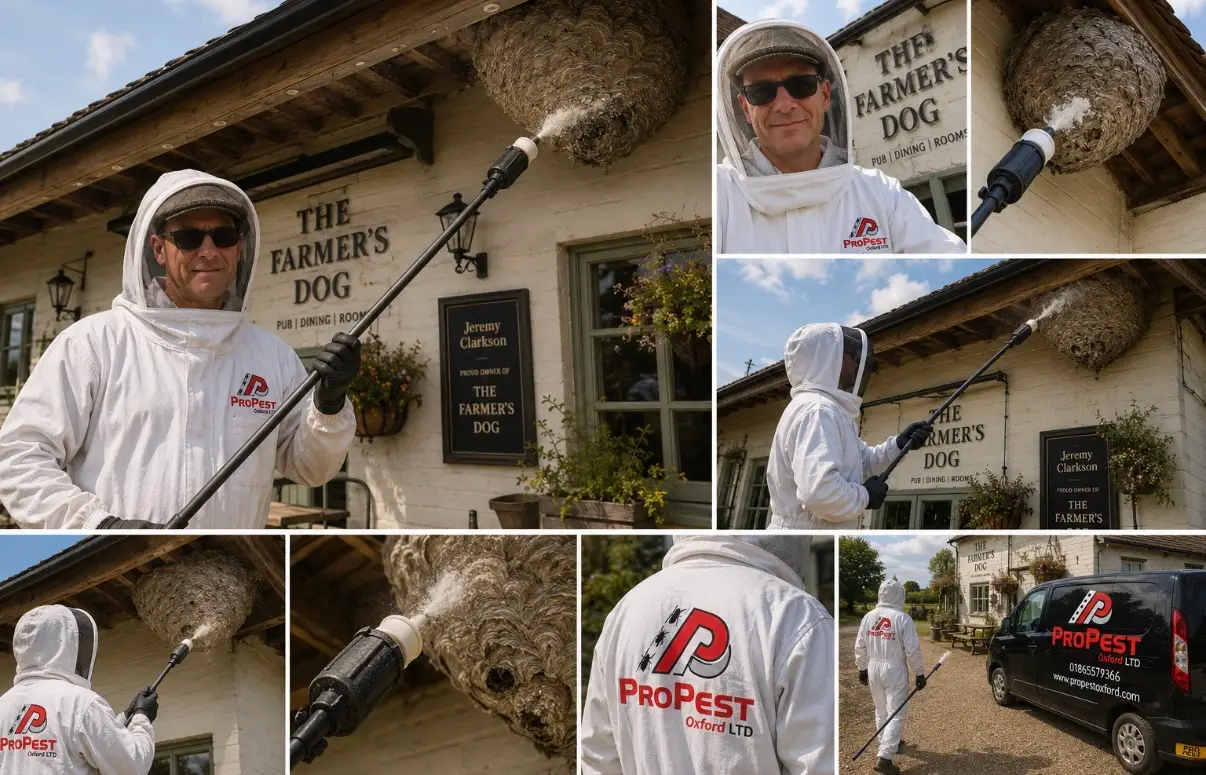
Wasp nest removal Oxford is provided by ProPest Oxford Ltd for homes and businesses across Oxfordshire. We assess the nest location and access, explain the proposed professional treatment and provide clear advice about what to expect afterwards. Check available appointment times through online booking.
Tell us where wasps are entering or leaving, whether the nest is close to an occupied room, and if access is difficult. Do not disturb a suspected nest while waiting for advice. If you are unsure whether the insects are wasps, hornets or bees, contact us for help with identification before choosing a service.
Read about our inspection and identification process and targeted pest control.
If you need Wasp Nest Removal Oxford, ProPest Oxford Ltd provides fast, professional and fully insured wasp nest removal throughout Oxfordshire. Our Wasp Nest Removal Oxford service covers homes, garages, lofts, sheds, wall cavities and commercial premises, with same-day appointments available wherever possible.
Every Wasp Nest Removal Oxford treatment is carried out by experienced technicians using professional equipment to ensure nests are removed safely and effectively.
Finding a wasp nest in or around your property can be worrying, particularly when large numbers of wasps are entering the roof, gathering near a doorway or appearing inside your home. ProPest provides fast, professional wasp nest removal throughout Oxford and Oxfordshire, with same-day and next-day appointments often available.
Wasps usually begin constructing their nests during spring. At first, the nest may be very small and easily overlooked, but activity becomes more noticeable as the colony develops. By the height of summer, an established nest can contain thousands of wasps travelling repeatedly between the colony and surrounding feeding areas.
A steady stream of wasps using the same small opening is one of the clearest signs of an active nest. You may see them disappearing beneath roof tiles, entering gaps in brickwork or flying through an air brick. Nests are also commonly found in lofts, sheds, garages, wall cavities, trees, hedges and underground spaces.
ProPest’s qualified pest controllers can identify the likely position of the colony and apply a professional treatment designed to control it at its source. We undertake wasp removal for homes, businesses, landlords, schools, hospitality premises and managed properties across Oxfordshire.
People describe this service in different ways. You may be looking for a local wasp pest controller, a wasp exterminator in Oxford or simply someone nearby who can deal with an active nest safely. Whatever brought you to this page, ProPest provides professional wasp treatment and colony control using approved pest-management products and specialist equipment.
Found an Active Wasp Nest?
Call ProPest or book online for professional wasp nest removal in Oxford and Oxfordshire. Same-day and next-day appointments are often available.
Signs of an Active Wasp Nest
Seeing an occasional wasp in the garden does not necessarily mean there is a nest on your property. Wasps naturally travel while looking for food, water and nesting materials. However, repeated activity around one particular opening usually indicates that a colony is established nearby.
Signs that you may require professional wasp control include:
● Wasps repeatedly following the same flight path
● Activity focused around one section of the roof or outside wall
● Wasps entering gaps beneath tiles, soffits or fascia boards
● Several wasps appearing inside the property
● A visible paper-like nest in a loft, shed, garage or tree
● Wasps entering a hole in the ground
● Increased defensive behaviour near a particular area
● Scratching or tapping sounds inside a ceiling or wall
A nest should be professionally assessed when it is close to a doorway, window, bedroom, footpath, children’s play area or another space that people cannot reasonably avoid. Prompt treatment is also advisable when the colony is affecting employees, customers, residents or anyone with a known allergy to wasp stings.
Wasps can sting repeatedly when defending their colony. Disturbing a nest, attempting to knock it down or spraying it while standing on a ladder can place you at considerable risk.
If someone develops difficulty breathing, swelling of the mouth or throat, dizziness or another serious reaction after being stung, call 999 immediately.
Wasp Nests in Lofts, Roofs and Wall Cavities
Many of the nests treated by ProPest are completely hidden from view. The customer may only see wasps entering a small gap beneath a roof tile or disappearing into the outside wall.
A wasp nest in a loft may be attached to timber, stored belongings or insulation. Nests can also be situated beneath roof tiles, inside soffits or deep within enclosed roof spaces. When wasps are entering the roof in a steady stream, the nest itself may be much further inside the structure than the visible entrance suggests.
It is important not to seal the opening while the colony remains active. Blocking the normal entrance can force the wasps to search for another route. If the nest is inside the building, they may move further into the roof space or emerge through ceilings, light fittings and ventilation openings.
The same warning applies to a wasp nest in a wall cavity. A small gap in mortar, brickwork or around pipework can provide access to a substantial concealed space. Sealing that opening before treatment does not eliminate the colony—it simply removes its established external route.
ProPest will examine the direction and concentration of activity to identify the most likely entrance. Professional application equipment then allows the treatment to be delivered into or around the active area, where returning wasps encounter it and transfer it further into the colony.
We also treat nests found in sheds, garages, gardens, trees and hedges. Underground wasp nests require particular care because gardening, lawnmowers, children or pets can easily disturb them. Pouring household substances into a ground nest or attempting to dig it out can provoke a significant defensive response.
Once the colony has been controlled, we can advise whether repairs or proofing would be beneficial. Any entry point should remain open until the activity has stopped and the nest is confirmed inactive.
Wasps Entering Your Roof or Wall?
Do not seal the entrance or attempt to treat a concealed nest yourself. ProPest can locate and control the colony safely before any proofing work is undertaken.
[Arrange Professional Treatment]
How Professional Wasp Treatment Works
When our technician arrives, they will inspect the reported activity, identify the likely nest position and make sure people and animals can be kept safely away from the treatment area.
The treatment method depends on the position of the colony. A visible nest in a shed requires a different approach from one concealed beneath roof tiles, inside a cavity wall or below ground. ProPest uses approved professional products and specialist application equipment appropriate to the circumstances.
Most established wasp nests can be controlled with one visit. Some activity may remain visible for a short period after treatment because individual wasps that were away from the colony will continue returning. These wasps should encounter the treatment when they reach the entrance, and the overall activity will steadily decline.
Professional wasp nest removal does not always mean physically taking away the paper nest. When a nest is situated inside a roof, wall cavity or another inaccessible space, opening the building could cause unnecessary damage without improving the result.
Once the colony has been successfully treated, the abandoned nest can usually remain where it is. Wasps do not return to reuse an old nest the following year. Where physical removal is practical and there is a particular reason for doing it, the technician can discuss the available options with you.
Qualifying treatments are covered by ProPest’s service guarantee. If the identified nest remains active beyond the advised treatment period, contact us so that the activity can be reviewed under the terms of that guarantee.
Fast, Guaranteed Wasp Nest Treatment
Most nests can be controlled with one professional visit. ProPest will also explain what to expect following treatment and when the affected area can be used normally again.
Can I Remove a Wasp Nest Myself?
DIY wasp nest removal is not recommended. An active colony can react defensively when its entrance or nest structure is disturbed, potentially exposing you and anyone nearby to multiple stings.
Shop-bought sprays may kill individual wasps without reaching the colony, particularly when the nest is concealed inside a roof or wall. Standing on a ladder while attempting to spray a nest creates the additional risk of falling if the wasps begin attacking.
Never strike a wall to locate a nest, block an active entrance or attempt to burn, flood or dig out a colony. The safest approach is to observe the flight path from a reasonable distance and leave the treatment to a qualified pest controller.
How Quickly Does Wasp Treatment Work?
The time required to complete a professional treatment depends upon access and the nest’s location. Many routine treatments can be carried out during a relatively short appointment, although the technician must first assess the site and establish a safe working area.
A reduction in activity should become apparent following treatment, but complete control is not necessarily instantaneous. Foraging wasps can remain away from the nest for some time and may continue returning later in the day.
Do not touch the treated surface or immediately close the entrance. Keep children and animals away for the period advised by the technician and follow the guidance provided after treatment.
If qualifying activity continues beyond the expected control period stated by ProPest, contact us for further advice.
Hornet Nest Removal and Insect Identification
ProPest also provides professional hornet nest removal across Oxford and Oxfordshire. European hornets are considerably larger than common wasps and their appearance can be intimidating, although their size does not automatically mean they are more aggressive.
Hornets may establish colonies in roof spaces, wall cavities, trees and outbuildings. The same general safety principles apply: do not disturb the nest, seal its entrance or attempt to remove it without the correct protective equipment.
Bees, wasps and hornets are sometimes confused with one another, so correct identification is important. Not every flying insect requires pest-control treatment, and bees should be handled differently from wasps. If you are unsure, send ProPest a clear photograph taken from a safe distance. We may be able to identify the insect before arranging a visit.
Suspected Asian hornet sightings should be reported through the official government reporting system. Asian hornets are an invasive species and are dealt with through a nationally coordinated monitoring and control programme.
Residential Wasp Control in Oxford
Our residential service covers houses, flats, gardens, lofts, garages, sheds and other outbuildings. We also work with landlords, letting agents and property managers who require prompt treatment at occupied or vacant properties.
Wasp activity can be particularly concerning when the nest is situated near a child’s bedroom, garden seating area or main entrance. ProPest will assess the location, explain the proposed treatment and provide the relevant safety instructions before work begins.
Customers searching for wasp nest removal near them can speak directly to an established Oxford pest-control company rather than relying on a distant national call centre. Appointments are available seven days a week between 7:30am and 7:30pm.
Commercial Wasp Pest Control
Wasps can create a serious operational problem for restaurants, cafés, pubs, shops, schools, offices, warehouses, care facilities and other commercial premises.
Activity around bins, outdoor seating, food areas and customer entrances can quickly generate complaints and expose employees or visitors to stings. A hidden nest inside the building can also result in wasps appearing in offices, bedrooms, kitchens or public areas.
ProPest provides discreet commercial wasp control designed to minimise disruption while resolving the active colony. Where appropriate, we can also advise on waste management, building maintenance and proofing measures that may reduce future problems.
How Much Does Wasp Nest Removal Cost in Oxford?
ProPest provides clear pricing for standard wasp nest treatments. The cost may be affected when specialist access equipment is required, unusual working conditions are present or several separate nests need to be treated. Any additional charge will be explained before treatment begins.
Customers looking for affordable wasp nest removal should compare more than the initial callout price. Professional qualifications, insurance, treatment standards, aftercare and a genuine service guarantee are all important.
A cheap advertised price may not include follow-up support or treatment by an appropriately qualified technician. ProPest provides clear pricing and does not deliberately add hidden charges after attendance.
Customers can arrange treatment directly through our online booking system without waiting for a callback.
Clear Pricing with No Hidden Surprises
Book professional wasp nest removal with a qualified and insured local technician. Any additional cost for unusual access or multiple nests will be explained before treatment begins.
Wasp Nest Removal Across Oxford
ProPest is based in Oxford and provides local wasp control throughout the city. Our service area includes Littlemore, Cowley, Rose Hill, Iffley, Headington, Sandford-on-Thames, Kennington and surrounding communities.
Being locally based helps us provide prompt appointments across Oxford. Same-day attendance is often possible, depending on technician availability and the location of the property. When this is not possible, we will offer the earliest suitable next-day appointment.
We also provide weekend and Sunday wasp nest removal during our published operating hours. This can be especially helpful when a nest is discovered outside the normal working week or is affecting a commercial premises during its busiest period.
Wasp Nest Removal Across Oxfordshire
Our wider Oxfordshire coverage includes Kidlington, Wheatley, Abingdon, Didcot, Wallingford, Witney, Carterton, Bicester, Banbury, Wantage, Thame, Chipping Norton and Henley-on-Thames.
ProPest also attends many smaller towns and villages across the county. If your location is not listed, please contact us because we may still be able to provide local wasp or hornet treatment.
Whether you need wasp nest removal in Abingdon, wasp control in Didcot, a wasp pest controller in Bicester or hornet nest removal near Witney, our team will offer the earliest practical appointment.
Need a Local Wasp Pest Controller?
Whether you searched for wasp nest removal near me, urgent wasp control in Oxford or hornet nest removal in Oxfordshire, ProPest is ready to help.
[Book Your Local ProPest Technician]
Why Choose ProPest?
All work is undertaken by trained and insured pest-management professionals. ProPest technicians hold a minimum RSPH Level 2 qualification, and the company is associated with the NPTA and BASIS PROMPT.
Our customers benefit from:
● Same-day or next-day appointments whenever available
● Service seven days a week
● Qualified and insured pest-control technicians
● Professional treatment products and application equipment
● Residential and commercial experience
● Clear pricing before treatment begins
● Guaranteed qualifying wasp nest treatments
● Local Oxford and Oxfordshire coverage
● Convenient online booking
● Practical advice following treatment
Book Wasp Nest Removal in Oxford Today
Do not disturb an active nest or seal its entrance while wasps are still using it. Contact ProPest or use our online booking service to arrange professional wasp nest removal in Oxford or Oxfordshire.
When contacting us, explain where the wasps are entering, whether the nest itself is visible and whether anyone at the property has a known allergy. A photograph of the insect or entry point may also help us prepare for the visit.
Whether you need urgent wasp control, have found a hornet nest or simply want an experienced pest controller to identify the problem, ProPest is ready to help.
Call ProPest or book online for fast, professional wasp and hornet nest treatment. Same-day and next-day appointments are often available.
Common names: Yellow jacket, hornet
Scientific names: Vespula vulgaris, Vespula germanica, Vespa crabro
Wasps are fascinating and diverse insects belonging to the order Hymenoptera. They are recognised by their distinctive yellow and black markings, although some species vary in colour. Unlike bees, wasps have less hair and generally have slimmer bodies with a more pronounced waist.
Female wasps possess a stinger and can sting repeatedly without dying. Their venom can cause pain and swelling and, in rare cases, a serious allergic reaction. If a nest is close to your home, garden or workplace, our professional wasp nest removal Oxford service provides a safe and effective solution.
Wasps play an important role in the ecosystem as pollinators and natural pest controllers, feeding on many other insects. However, they can become a danger when a nest is built near people, children or pets. Never attempt to disturb or remove an active nest yourself.
Wasp colonies begin when a queen emerges from hibernation during spring and starts building a nest. She lays the first eggs, which develop into worker wasps that expand the nest throughout the summer. If you notice frequent wasp activity around your property, contact ProPest Oxford for professional wasp nest removal Oxford residents can rely on
Wasps are extremely adaptable and can be found in urban areas, countryside, forests and wetlands. They build their nests from wood fibres mixed with saliva, creating a paper-like material. Nests are commonly found underground, beneath roof eaves, inside wall cavities, in lofts, sheds and trees. If you discover an active nest in or around your property, our professional wasp nest removal Oxford service provides a safe and effective solution.
Some species, including hornets, can build large nests containing thousands of individuals. These intricate structures may become dangerous when located close to people, children or pets. ProPest Oxford provides reliable wasp nest removal Oxford residents and businesses can book seven days a week.
The wasp colony is divided into three primary roles: the queen, the workers, and the males (drones). The queen is the only wasp in the colony that lays eggs. Workers, which are sterile females, perform various tasks such as foraging, nest building, and defending the nest. Males are produced later in the season, primarily for the purpose of mating with new queens.
The life cycle of a wasp begins as an egg. After hatching, the larvae are fed by the workers until they pupate and eventually emerge as adults. In temperate climates, most colonies do not survive the winter, and new colonies are established each spring by overwintering queens.
Wasps are omnivores, with diets that vary depending on the species and time of year. Early in the year, they primarily consume nectar and other sugary substances. As the season progresses, they become more carnivorous, feeding on insects such as flies, caterpillars, and spiders. This predatory behaviour makes them important in controlling pest populations.
In urban and suburban areas, wasps are often drawn to human activities, especially where food or sugary drinks are present. They can be particularly bothersome during outdoor activities like picnics and barbecues.
Identifying a wasp infestation primarily involves noticing an increased presence of wasps flying around, especially in a repetitive flight pattern, which indicates they are entering and exiting a nest nearby.
The most definitive sign of an infestation is the presence of a nest. Wasp nests have a unique, rounded, papery appearance and can vary greatly in size.
You may also observe wasps hovering around specific areas, particularly where food or sweet substances are exposed.
Handling a wasp infestation can be dangerous, particularly when dealing with a large nest or for individuals with allergies to stings. Therefore, it’s recommended to seek professional pest control services for safe and effective removal of wasp nests.
Professionals like ProPest have the expertise, equipment, and protective gear necessary to safely remove wasp nests. They can also provide advice on preventing future infestations and can treat areas to deter wasps from returning.